
Without mandatory federal quality standards, the difference between a well-made CBD product and a questionable one comes down to the voluntary standards a manufacturer chooses to follow. Understanding these standards — extraction methods, lab testing protocols, and manufacturing certifications — is the only reliable way to evaluate what you're buying.
Extraction Methods
The extraction method determines the purity, safety, and cannabinoid profile of the final product. The three dominant methods in commercial CBD production:
- Supercritical CO2 Extraction
- Uses pressurized carbon dioxide to pull cannabinoids from hemp biomass. Considered the gold standard: no residual solvents, precise control over which compounds are extracted, and a clean final product. Higher equipment cost, but the method of choice for premium brands. Journal of Supercritical Fluids, 2018
- Ethanol Extraction
- Uses food-grade ethanol to dissolve cannabinoids. Efficient at scale and capable of producing full-spectrum extracts. Requires careful post-processing to remove solvent residue. Widely used by mid-market and large-scale manufacturers.
- Hydrocarbon Extraction (Butane/Propane)
- Common in THC cannabis markets but less preferred for CBD supplements. Produces potent concentrates but carries residual solvent risk if not properly purged. Generally avoided by brands targeting the wellness market.
Third-Party Lab Testing (COA Standards)
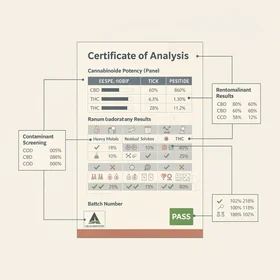
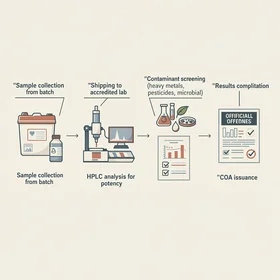
A Certificate of Analysis (COA) is the single most important quality indicator for any CBD product. But not all COAs are created equal. Here's what a legitimate COA should include:
| Test Panel | What It Measures | Why It Matters |
|---|---|---|
| Cannabinoid Potency | CBD, THC, CBG, CBN, and other cannabinoid levels | Confirms label accuracy and legal THC compliance |
| Pesticide Screen | 60+ pesticides and herbicides | Hemp is a bioaccumulator — it absorbs contaminants from soil |
| Heavy Metals | Lead, arsenic, mercury, cadmium | Same bioaccumulation risk; heavy metals concentrate in extracts |
| Residual Solvents | Butane, propane, ethanol, isopropanol | Ensures extraction solvents were fully removed |
| Microbial Contaminants | E. coli, salmonella, mold, yeast | Basic safety — especially for immunocompromised users |
| Mycotoxins | Aflatoxins, ochratoxin A | Mold byproducts that can cause serious health effects |
Red Flags in COAs
Even when a brand provides a COA, watch for these problems:
- In-house testing only. The lab should be independent and ISO 17025-accredited. If the brand tested its own product, the COA is meaningless.
- Batch numbers don't match. The COA should correspond to the specific batch on your product's label. A generic COA that doesn't reference a batch is a warning sign.
- Missing panels. If a COA only shows potency but skips pesticide, heavy metal, or solvent testing, the product hasn't been fully vetted.
- Potency mismatch. If the COA shows 22mg CBD per serving but the label says 25mg, that's more than acceptable manufacturing variance — it's a labeling problem.
cGMP Manufacturing
Current Good Manufacturing Practice (cGMP) regulations are FDA-enforced standards covering facility cleanliness, equipment maintenance, personnel training, production records, and quality control procedures. While cGMP compliance is required for dietary supplements under DSHEA, the FDA hasn't classified CBD as a supplement — so compliance is technically voluntary for CBD manufacturers.
In practice, the best CBD manufacturers follow cGMP regardless. Key elements include:
- Documented standard operating procedures (SOPs) for every production step
- Environmental monitoring and contamination controls
- Batch-level production and testing records
- Personnel training and hygiene requirements
- Equipment calibration and maintenance logs
cGMP certification is typically verified through third-party audits by organizations like NSF International or the Natural Products Association (NPA).
Alternatives to CBD
CBD is one of over 100 cannabinoids found in hemp. Depending on your goals, other options may be relevant:
- CBG (Cannabigerol): The "parent cannabinoid" from which other cannabinoids are synthesized. Early research suggests potential anti-inflammatory properties, but clinical evidence is limited.
- CBN (Cannabinol): A degradation product of THC. Marketed for sleep support, though published evidence is sparse. Often combined with CBD in sleep-targeted formulations.
- Hemp-derived THC beverages: For those in states where legal, products like Just Chill offer a 1:1 THC/CBD ratio (4mg each) in a craft tonic format — a different experience than CBD alone.
- Non-cannabinoid adaptogens: Ashwagandha, L-theanine, and magnesium glycinate address overlapping wellness goals (stress, sleep, calm) without any cannabinoid content.
None of these are direct replacements for CBD. They represent different points on the wellness spectrum, with varying levels of research support.
How to Evaluate a CBD Product: Step-by-Step
- Step 1: Check for a COA. Look for a QR code or link on the packaging. If there's no COA available, stop here — the product hasn't been independently verified.
- Step 2: Verify the lab. The COA should name an ISO 17025-accredited, independent laboratory. Search the lab name to confirm it's real and accredited.
- Step 3: Match the batch number. The batch or lot number on your product should match the one on the COA. A generic or undated COA is a red flag.
- Step 4: Check potency accuracy. Compare the CBD content on the COA to the label claim. Industry-accepted variance is plus or minus 10%. Larger discrepancies indicate quality problems.
- Step 5: Review contaminant panels. Confirm the COA includes pesticide, heavy metal, residual solvent, and microbial testing — and that all results are within acceptable limits.
- Step 6: Look for cGMP or third-party manufacturing certification. NSF International, NPA, or similar audit-based certifications indicate the manufacturer follows documented quality procedures.
Bottom Line
The absence of mandatory federal standards means quality evaluation falls on buyers. The three markers that matter most: CO2 or ethanol extraction, batch-specific COAs from an accredited independent lab, and cGMP manufacturing. Products meeting all three are a small fraction of the market — but they're the ones that will survive when regulation arrives. For the regulatory context behind these standards, see our federal policy analysis and state-by-state guide.